
 English
 中文简体

TBM crane
TBM crane
TBM crane
TBM crane
TBM crane
TBM crane
TBM crane
TBM crane
TBM crane
TBM crane
TBM crane
TBM crane
TBM crane

Industry News
 Nov 23 , 2026
what is a chain fall: Applications, Selection Criteria, and Practical Guidance
Nov 23 , 2026
Content
- 1 What Is a Chain Fall? A Plain Definition
- 2 How Does a Chain Fall Actually Lift a Load?
- 3 The Chain Fall Variants You Will Meet in the Field
- 4 Chain Fall or Wire Rope Hoist: Which Belongs in Your Building?
- 5 The Components That Decide How Long a Chain Fall Lasts
- 6 How to Choose the Right Chain Fall for Your Application
- 7 Where Chain Falls Earn Their Keep
- 8 Six Rules That Keep Chain Fall Operations Safe
- 9 Daily Checks and Periodic Inspections: Who Looks at What?
- 10 What to Ask Before You Place an Order
- 11 Frequently Asked Questions About Chain Falls
- 11.1 Is a chain fall the same as a chain hoist?
- 11.2 How much can a chain fall lift?
- 11.3 Can a chain fall be used outdoors?
- 11.4 Why does the chain sometimes jump or jam?
- 11.5 How long does a chain fall last?
- 11.6 Can the lift height be increased later?
- 11.7 What is the difference between a chain fall and a come-along?
Every workshop has one. A compact housing, a hook, a loop of hardened chain disappearing into a bag, and a control handle that a two-person team has learned to use without thinking about it. The chain fall is one of the plainest pieces of lifting hardware in existence, and yet it is frequently the last thing standing between a heavy component and the shop floor.
This guide explains what a chain fall is, how it actually lifts a load, which variants you will meet in the field, how to select one, and how to keep it safe over years of service. It is written for maintenance engineers, production planners and buyers who need to compare a chain fall against a wire rope hoist without wading through vendor brochures.
What Is a Chain Fall? A Plain Definition
A chain fall is a lifting device that raises and lowers a load by engaging a link chain against a grooved load wheel. Instead of winding a wire rope onto a drum, the chain fall grips the chain link by link, pulls it through the wheel and lets the slack fall into a collection bag beneath the housing. That single design decision explains almost everything else about the device: its compact footprint, its tolerance of dust and moisture, and its preference for short to medium lifting heights.
The name itself is descriptive. The "fall" refers to the chain that falls away from the load wheel once the hook has been raised, gathering loosely in the chain bag. In North America, "chain fall" and "chain hoist" are used almost interchangeably. In the United Kingdom, Europe and most export markets, "chain block" or "chain hoist" is the more common term, and in Chinese manufacturing the product family is usually described as an electric chain hoist. All of these names refer to the same working principle.
Three characteristics separate a chain fall from other lifting gear:
- It uses a link chain as the load-bearing element, not a wire rope or a synthetic sling.
- The chain is held by a grooved wheel rather than wound onto a drum, so there is no spooling to manage.
- It can be powered by hand, by an electric motor or by compressed air, which makes the same basic mechanism available from a remote site with no power supply to a busy production line.
It is worth clearing up one frequent confusion: a chain fall is not a load binder or a come-along. Those tools pull and tension, and they are not rated for overhead lifting. A chain fall is a hoist, designed to suspend a load and move it vertically under control.
| Parameter | Typical range or value | Why it matters |
|---|---|---|
| Rated capacity | 0.25–20 t manual, 0.5–5 t electric | Sets the heaviest load the unit can lift safely |
| Standard lift height | 3 m, extendable to 12 m or more | Must cover the hook travel between the highest and lowest working positions |
| Chain grade | High-strength link chain to EN 818-7 or ISO 3077 | Determines wear life and the safety margin behind the rating |
| Duty class | ISO M3–M6 (FEM 1Am–2m) | Matches the hoist to how often and how hard it will actually work |
| Electric lifting speed | 4–8 m/min single speed, down to about 0.8 m/min in dual speed | Balances fast transfer against fine positioning |
| Power supply | 380–415 V three phase, 50/60 Hz | Determines whether the unit can be moved between workstations |
Those figures are a starting point, not a specification. The actual numbers depend on the model, the manufacturer and the intended market, and they should always be confirmed against the nameplate before any lift is planned.
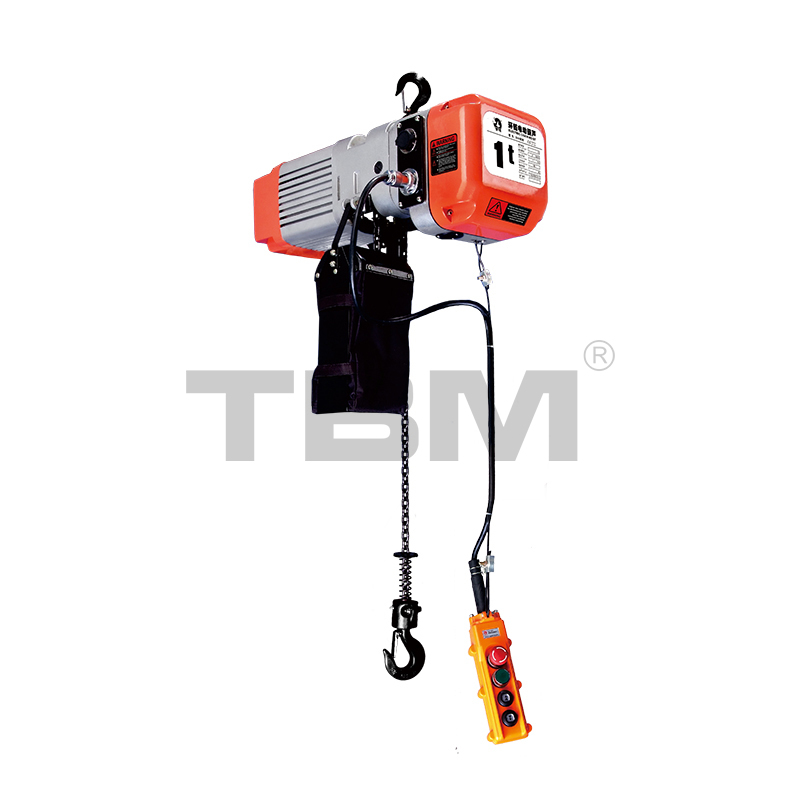 SHH-A Electric Chain Hoist for Demanding EnvironmentsConfigurable electric chain hoist with modular parts and options for cleanroom, corrosive, stage, and wind-power duties; confirm ratings on the nameplate.View Product →
How Does a Chain Fall Actually Lift a Load?
Whether the input comes from a human hand or from an electric motor, the core mechanism is the same. A driver turns a small sprocket, a gear train multiplies the torque, and the load wheel turns slowly with a great deal of force. The chain links sit inside the pockets of the load wheel, so each rotation advances the chain by a fixed number of links. Nothing grips by friction alone, which is why a chain fall can hold a load without slipping even after a long pause.
Manual chain fall
The operator pulls a thin hand chain. That chain drives a small hand wheel, which is connected to the load wheel through a reduction gear set. Ratios of roughly 20:1 to 60:1 are common, which is why a pull of a few kilograms can raise half a tonne.
- A mechanical brake, usually a friction disc with a ratchet or twin pawl, locks the load the instant the operator lets go.
- No power supply is needed, so the unit is genuinely portable.
- Lifting speed depends entirely on the operator and the height of the lift.
Electric chain fall
A motor drives the reduction gear, and the load wheel pulls the chain through. A spring-applied brake clamps down whenever power is removed, so the load stays where it was left.
- Limit switches stop the hook at both ends of its travel, protecting the gearbox from being jammed against the housing.
- Dual-speed models allow fast transfer followed by slow, controlled final positioning.
- Control is by pendant push button, and in many installations by wireless remote.
In both versions, the load wheel is the component that deserves the most attention. Its pockets must match the chain grade and pitch exactly, and the chain must be free to articulate as it enters and leaves the wheel. A twisted or kinked chain does not sit properly in the pockets, and that is the usual origin of the jumping and jamming complaints that operators report.
The Chain Fall Variants You Will Meet in the Field
The basic mechanism has been adapted into a surprisingly broad family of products. Each variant solves a specific problem, and choosing the wrong one is a common reason a lifting job feels harder than it should.
Hand chain fall
The classic maintenance tool. Pulled by hand, needs no power, and can be carried to a remote site. Common in capacities from 0.25 t to 20 t and normally supplied with a 3 m lift.
Lever chain hoist
Instead of a hand chain, a lever is worked up and down. Popular for tensioning, positioning and short precision lifts, and useful where there is no room to stand and pull a hand chain.
Electric chain fall
Motor driven and usually hung from a trolley or a fixed bracket. The workhorse of assembly lines, where the same load is lifted hundreds of times a shift.
Pneumatic chain fall
Driven by compressed air. Preferred where electrical equipment is unwelcome, and useful in hot, humid or heavily contaminated atmospheres where a motor would suffer.
Trolley-mounted unit
Fitted with a plain or geared trolley on a beam flange. Converts a vertical hoist into a two-axis lifting point that can travel along a runway.
Low headroom version
The hook sits close to the beam, buying valuable centimetres under the structure. Essential in older buildings where every millimetre of headroom has already been used.
Corrosion-resistant version
Marine and coastal installations call for treated chains, sealed housings and stainless hardware. The mechanism is the same, but the materials are selected for salt and humidity.
Chain Fall or Wire Rope Hoist: Which Belongs in Your Building?
Both devices lift. The difference is how they store the lifting medium, and that difference ripples through speed, height, maintenance and cost. The comparison below is deliberately practical rather than absolute, because a well-specified hoist of either type will outperform a poorly specified one of the other.
| Criterion | Chain fall | Wire rope hoist |
|---|---|---|
| Lifting medium | Link chain engaging a grooved wheel | Wire rope wound on a drum |
| Common capacity range | 0.25–20 t | 0.5–50 t and beyond |
| Typical lift height | 3–12 m | 6–60 m |
| Lifting speed | Moderate | Higher |
| Tolerance of dust and moisture | Good | Moderate |
| Hook movement when empty | Light and easy | Heavier, more effort |
| Long lift heights | Chain weight grows quickly | Less penalised by its own weight |
| Positioning accuracy | High, link by link | Good, but with more drift |
| Main wear item | Chain and load wheel | Wire rope and rope guide |
The short version: if the loads are moderate, the lift heights are short, the environment is gritty, and the hook needs to travel along a workbench, a chain fall is usually the better fit. If the loads are heavy, the lift heights are long, and throughput matters more than delicacy, a wire rope hoist earns its place. Many modern workshops end up with both, each doing what it does best.
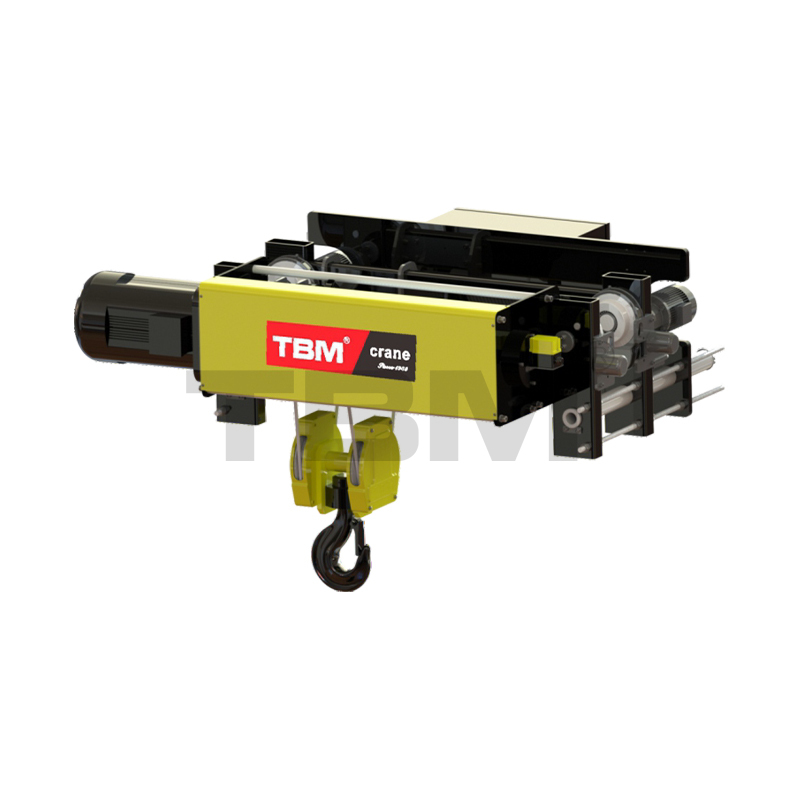 SHA7 Electric Wire Rope Hoist VariantsCustomizable wire rope hoist offered in low-headroom, double-girder, and standard-headroom variants; compare with chain fall needs before specifying.View Product →
The Components That Decide How Long a Chain Fall Lasts
A chain fall is a small machine, but every part of it is loaded every time the hook moves. Understanding what each component does makes inspection far more meaningful, because you know what a worn part looks like and what it is telling you.
Hook and safety latch
Forged and heat treated, with a spring latch that stops the sling from slipping out. Hook opening, wear at the saddle and any twist are checked at every inspection.
Load chain
High-strength alloy chain, normally grade T or 8, manufactured and proof tested to a recognised standard. Wear, elongation, nicks and corrosion are the four things to watch.
Load wheel
The grooved wheel that engages the chain. Pockets must be clean and unworn; a damaged pocket starts damaging the chain on the very next lift.
Gear train
Reduces speed and multiplies torque. Sealed and lubricated for life in most modern designs, which is why gearbox noise is treated as a warning sign.
Brake
Holds the load when input stops. A brake that lets a load creep downwards is a defect, not a quirk, and the unit should be taken out of service.
Limit switches
Stop the hook before it reaches the housing. They are a safety backstop, never a normal way of stopping the lift, because repeated use wears them out.
Chain bag
Collects the slack chain and keeps it away from the load path. A torn bag allows the chain to drag on the floor, which quietly accelerates wear.
Controls
Pendant, push button or wireless remote. Cable strain relief and sealed enclosures matter more than most buyers expect in a wet or dusty plant.
How to Choose the Right Chain Fall for Your Application
Most selection errors come from one of two directions: buying on price alone and discovering the unit cannot handle the duty cycle, or over-specifying and paying for capacity that will never be used. A structured approach avoids both.
The chart below shows the relative mechanical duty that each common ISO work class is expected to withstand. It is an index for comparison, not a specification for any particular hoist.
Relative duty expectation across the common ISO work classes. Higher classes require heavier construction and shorter maintenance intervals.
With that in mind, work through the following sequence in order. Each answer narrows the field before the next question is asked.
- Establish the heaviest load, including the weight of slings, spreader beams and any fixtures that travel with the hook.
- Measure the lift height from the lowest working position to the highest, and add a margin for the hook block itself.
- Estimate how many lifts per shift the unit will actually perform, then select a duty class that is above, not equal to, that figure.
- Describe the environment: dust, humidity, salt, ambient temperature, and whether the atmosphere is classified as hazardous.
- Confirm the available power supply and whether the unit needs to move between workstations.
- Measure headroom. If the structure sits low, a low headroom version may be the only way to keep the hook usable.
- Decide how the hoist will be mounted: fixed bracket, plain trolley, geared trolley, jib crane or a light crane system.
- Choose the control method, taking into account how far the operator stands from the load during a typical lift.
One final point that buyers often overlook: the lift height a unit is ordered with is not easily changed later. A chain fall supplied with a 3 m lift can be fitted with a longer chain, but the housing, the bag and the limit switch positions all need to be revisited. Getting that number right at the order stage is far cheaper than correcting it on site.
Where Chain Falls Earn Their Keep
The same compact mechanism fits into an unusually wide range of workplaces. The pattern across all of them is similar: repeated vertical movement of a moderate load, within a short radius, often by a single operator.
Machining and assembly
Loading fixtures, turning heavy components and holding parts in position while they are bolted. The slow, precise control of a chain fall is exactly what this work needs.
Warehouse and dispatch
Lifting crates and pallets where a forklift cannot reach, or where the load has to be suspended rather than supported from below.
Plant maintenance
Pulling pumps, motors and valves out of pipework, and holding them steady while gaskets and couplings are replaced.
Shipyards and marine work
Handling steel sections and engine parts in a salt-laden atmosphere, where corrosion-resistant construction and frequent inspection are both essential.
Steel erection and outdoor work
Positioning beams and bracing where no crane access exists and the hoist has to be carried to the workface by hand.
Workstation and line lifting
Suspended from a light crane system, a chain fall turns a single fixed point into a travel path that follows a production line or covers a bay.
In the last of those categories, the hoist is only half of the installation. The supporting structure, the rail layout and the trolley all determine how much of the bay the hook can actually reach. A chain fall hanging from a well-planned light crane system often does more useful work than a larger hoist bolted to a single point in the corner.
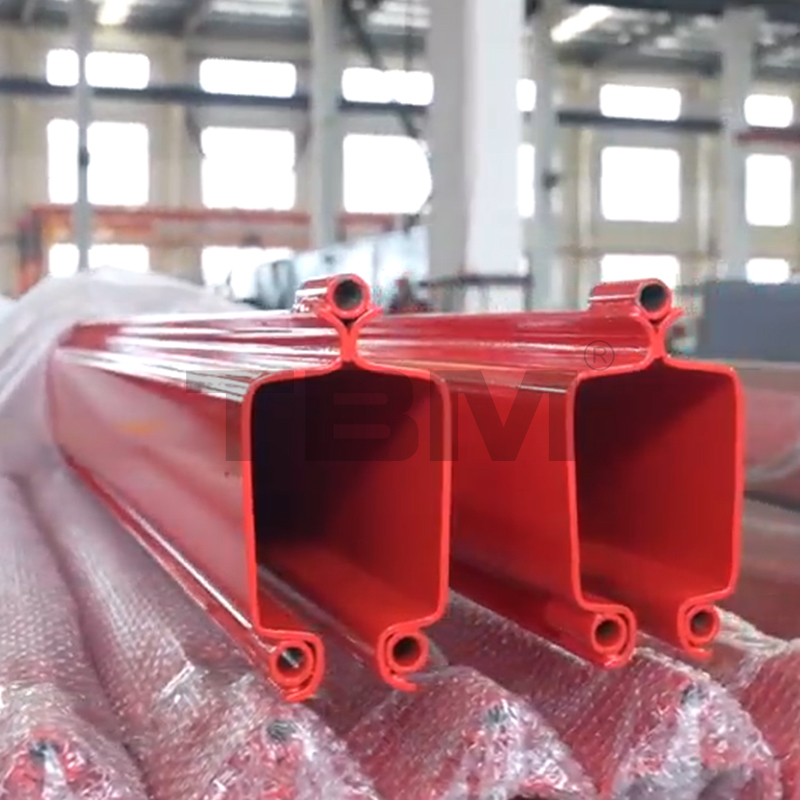 KBK Light Crane System for Flexible WorkstationsModular light crane system with 0.125t–2t capacity, monorail and beam options, and customizable rails; useful where hook coverage and layout matter.View Product →
Six Rules That Keep Chain Fall Operations Safe
Chain falls fail for predictable reasons: overloading, side pulling, worn chain, a brake that creeps, or a person standing in the wrong place. None of those failures is mysterious, and none of them requires a complicated procedure to prevent.
1. Inspect before every shift
Look at the hook, the latch, the chain, the load wheel and the limit switches. Pull the chain through by hand to confirm it runs freely and does not twist.
2. Check the rating against the load
Add the sling and fixture weight to the payload. A 2 t hoist lifting a 1.9 t part with a 200 kg spreader beam is overloaded, even though each number looks acceptable on its own.
3. Lift vertically
Side pulling forces the chain against the edge of the load wheel pocket and can bend the housing. If the load has to move horizontally, move the hoist, not the load.
4. Centre the hook over the load
The hook should sit directly above the centre of gravity before tension is applied. Off-centre lifting produces swing, and swing produces injuries.
5. Keep people out of the drop zone
Never stand under a suspended load, never ride the hook, and never use the limit switch as a normal stopping point. Move the load close to the ground before anyone walks beneath it.
6. Park the hoist properly
At the end of the shift, raise the empty hook to roughly two metres, switch off the power and store the controls out of the way. Parking with the hook at working height invites accidental contact.
Daily Checks and Periodic Inspections: Who Looks at What?
There is a useful division of labour in a well-run plant. The operator catches the obvious problems before they become incidents, and the maintenance team catches the slow deterioration that the operator is not trained to measure. Both are necessary.
Operator: every shift
- Hook cracks, distortion or a missing safety latch
- Chain kinks, twists, nicks and visible corrosion
- Brake holding the load without creep
- Limit switch stopping the hook before the housing
- Pendant or remote responding cleanly
- Chain bag intact and the slack chain clear of the floor
Maintenance: at set intervals
- Measured chain wear against the discard limit
- Chain elongation checked over a defined number of links
- Load wheel pocket profile and housing condition
- Gearbox noise, seals and lubrication
- Brake clearance and adjustment
- Electrical connections, cable glands and earthing
Chain wear is the measurement that most often gets skipped, because it requires a gauge rather than a glance. The widely applied discard criteria in European practice are straightforward: a chain is removed from service when the link thickness at the wear point has reduced by about 10 percent of the nominal diameter, when elongation across a defined number of links exceeds roughly 5 percent, or when any link shows cracks, deep gouges or severe corrosion. That last clause matters, because a chain can pass a dimensional check and still be unfit for lifting.
Lubrication deserves a mention too. Chain should be lightly oiled along its length, using a lubricant that penetrates the link joints rather than one that simply coats the outside. A dry chain wears quickly and starts to squeal, and by the time it squeals the wear has already happened.
Frequently Asked Questions About Chain Falls
Is a chain fall the same as a chain hoist?
Effectively yes. "Chain fall" is the common North American term, while "chain hoist" and "chain block" are used elsewhere. All three describe a device that lifts by engaging a link chain against a grooved wheel.
How much can a chain fall lift?
Manual units typically cover 0.25 t to 20 t, while electric models commonly run from 0.5 t to 5 t. The actual capacity is always the figure on the nameplate, and the sling and fixture weight must be counted against it.
Can a chain fall be used outdoors?
Yes, provided the unit is rated for the conditions. Rain, dust and salt all accelerate wear, so corrosion-resistant chains, sealed housings and a shorter inspection interval are sensible precautions.
Why does the chain sometimes jump or jam?
Almost always because the chain is twisted, kinked or worn, or because the load wheel pockets are damaged. Stop using the hoist, straighten or replace the chain, and inspect the wheel before the next lift.
How long does a chain fall last?
That depends far more on duty cycle and environment than on calendar age. A lightly used unit in a clean workshop can serve for many years, while a heavily used unit in a foundry may need a new chain within a couple of years. Inspection, not the date of purchase, determines when it is retired.
Can the lift height be increased later?
It can, by fitting a longer chain, but the chain bag, the limit switch positions and sometimes the housing need to be considered. Specifying the correct lift height at the order stage is much cheaper than correcting it afterwards.
What is the difference between a chain fall and a come-along?
A come-along is a pulling and tensioning tool and is not rated for overhead lifting. A chain fall is a hoist, designed to suspend and lower a load under control.
News

The company has always attached great importance to new product development and technological innovation, focusing on a high starting point, high configuration
Product Categories
Contact Us

No. 9 Tenglong Road, Huangze Industrial Function Zone, Huangze Town, Shengzhou City, Zhejiang Province, China

info@tbmhoist.com

+86 - 18957539688
