
 English
 中文简体
中文简体
TBM crane
TBM crane
TBM crane
TBM crane
TBM crane
TBM crane
TBM crane
TBM crane
TBM crane
TBM crane
TBM crane
TBM crane
TBM crane

Industry News
 Sep 21 , 2026
What Factors Impact Hoist Performance? Load, Duty, Speed, Environment, and Maintenance
Sep 21 , 2026
Content
Imagine a new wire rope hoist that handles its rated load on the first day, but then begins to run slower, overheat, or trip the thermal relay after a few weeks. The cause is usually not a defective hoist. It is a mismatch between the hoist's performance envelope and the actual operating conditions. Rated capacity is only the first variable. In practice, the factors that impact hoist performance fall into a few interconnected categories: the load path, duty cycle, lifting speed and control, power supply, installation fit, operating environment, and maintenance regime.
Load Characteristics: What Actually Reaches the Hook
Rated capacity assumes a centered, static, straight-line pull. Real lifting rarely matches that ideal. When a load is suspended off-center, swung during travel, or lifted with an angled sling, the hook experiences side forces and dynamic loads that exceed the nominal weight. A 10-ton hoist lifting a 9-ton load with a 10-degree sling angle sees an effective pull of about 9.14 tons. Add a short swing and the dynamic peak can pass 10 tons. That extra load goes straight into the motor, brake, and wire rope.
This is why asking only for total weight is not enough. The customer should also define the lifting method, whether the load has a known center of gravity, and whether the crane movement will create load swing. For a load that travels on fixed guide rails, a higher initial speed is acceptable. For a free-standing precision component, the same hoist should be equipped with a slow approach mode to avoid impact and protect the tooling.
Duty Cycle and Thermal Demand
The same hoist can exhibit a completely different service life depending on how often it runs and how heavy the average lift is. Hoist duty classes are designed to capture this difference. A maintenance hoist used twenty times a day with light loads needs less thermal capacity than a hoist loading a conveyor twenty times per hour with nearly full loads. The relevant parameters are starts per hour, running time under load, average load factor, and ambient temperature.
| Duty class | Typical application | Load spectrum | Thermal demand |
|---|---|---|---|
| M3 | Occasional lifting, maintenance | Light | Low |
| M5 | General workshop handling | Medium | Moderate |
| M7 | Continuous process handling | Heavy | High |
When the duty class is ignored, the motor can overheat, the brake may fade, and the thermal protection relay will interrupt production exactly when the pressure is highest. To avoid this, the buyer should provide the average lifting weight, the number of starts per hour, the operating hours per day, and the highest ambient temperature. These values determine the correct motor power, cooling design, and brake size.
- Estimate the average load factor by dividing the actual average lifted weight by the rated capacity.
- Record the cycles per hour and the real time under load, not just the total switch-on time.
- Add the maximum ambient temperature; a dusty or poorly ventilated area reduces cooling efficiency.
Lift Height, Speed, and Load Control
Lift height influences the rope length and the drum capacity. A high lift requires more wire rope on the drum, which increases the overall hoist length and can make the rope lead angle larger. For buildings with limited headroom, the choice of a compact hoist matters more than the rated tonnage alone.
Lifting speed affects both productivity and positioning accuracy. A single-speed hoist is acceptable for simple lifting, but a dual-speed or variable-frequency drive gives the slow approach required to set a load down without shock. Variable frequency drives also allow the operator to adjust the speed according to the load, which is useful when the same hoist is used for a wide range of weights. A VFD reduces load swing by allowing a controlled acceleration curve.
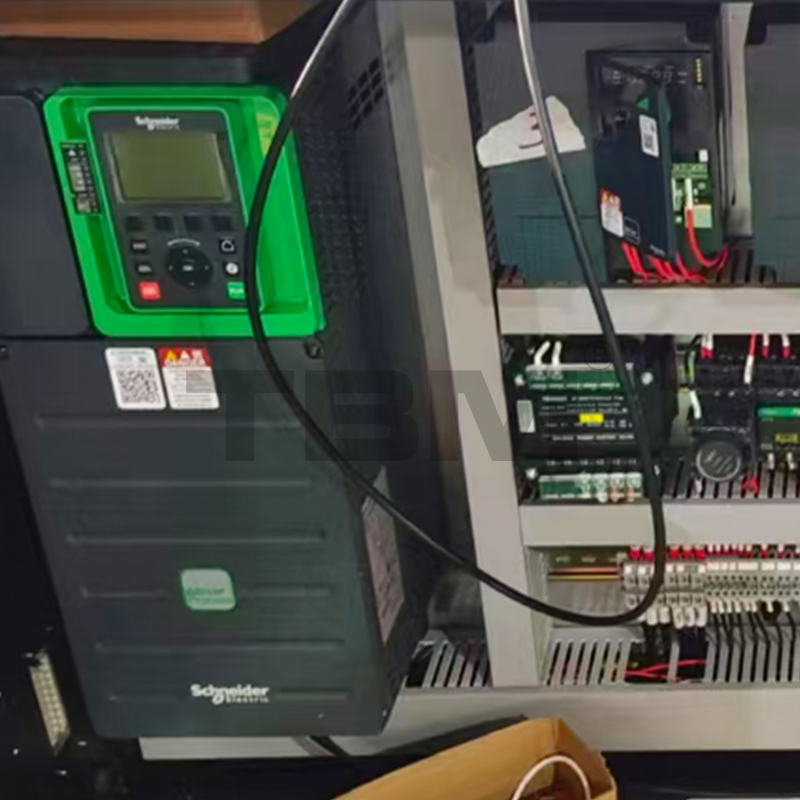 Crane Inverter for Precise Motor Speed and Torque ControlThis variable frequency drive adjusts motor speed and torque for smooth acceleration and deceleration, reducing load swing and energy consumption. It is especially useful when lifting a wide range of weights and requires controlled speed changes for accurate load placement.View Product →
Power Supply and Control Arrangement
The available voltage, frequency, and phase configuration must match the motor. A supply voltage drop of more than 10 percent under load can reduce torque and make the hoist appear weaker than its actual rating. The control arrangement also affects how the operator uses the hoist. A pendant control is simple and reliable. A wireless remote control improves mobility and line of sight, but it should be selected with attention to the number of channels and the operating range in the work area.
Control equipment is not a separate afterthought. A proper control box with short-circuit and thermal protection prevents a stalled motor from burning out. The wiring must be suitable for the actual current of the hoist. If the controls are not matched to the operating environment, electrical components will wear faster and produce intermittent faults.
Environment and Protection
Even a correctly selected hoist can have a short service life if it is placed in the wrong environment. Dust, moisture, salt spray, and corrosive vapors affect the motor insulation, brake mechanism, and electrical contacts. For indoor workshop use, a standard industrial enclosure may be sufficient. For outdoor applications, the hoist needs a higher ingress protection rating and corrosion-resistant surfaces.
High ambient temperature reduces the heat radiating capacity of the motor. In a hot factory, the same duty class may require a larger motor or a forced cooling fan. Low temperatures can make seals brittle and reduce the flexibility of the brake mechanism. In marine or humid environments, a marine-duty electric chain hoist is a practical solution because it is designed with salt-resistant coatings and increased moisture protection.
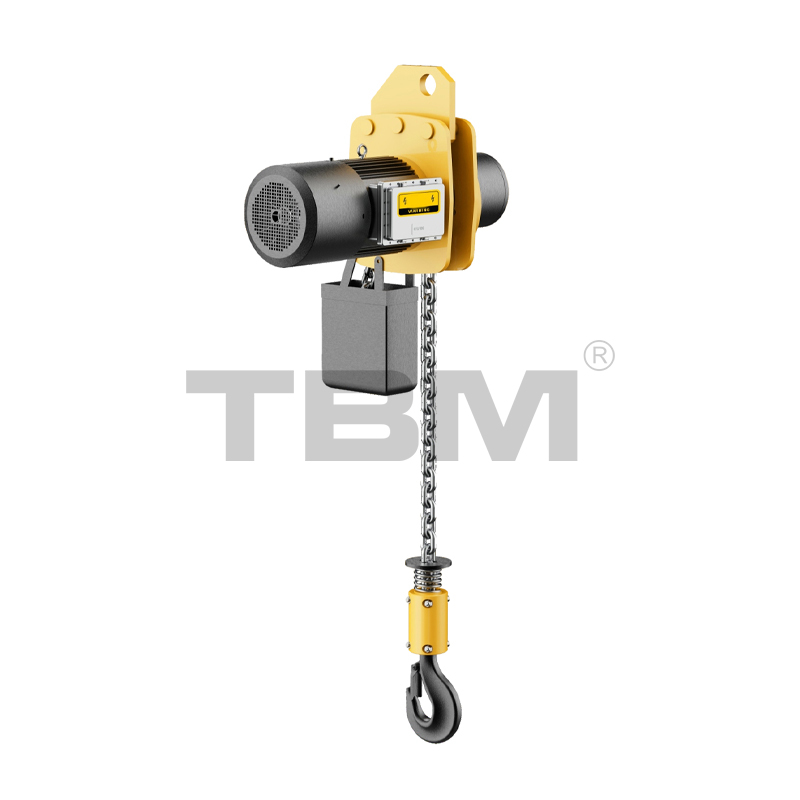 Marine Electric Chain Hoist with Corrosion Protection FeaturesBuilt for shipbuilding, galvanizing, and hydropower industries, this hoist features salt-resistant coatings and increased moisture protection. It is a practical choice for humid or marine environments where standard hoists may suffer from corrosion and seal failure.View Product →
Installation Fit and Trolley Interface
The hoist does not work alone. It has to fit the headroom, the beam size, and the trolley arrangement. A low-headroom hoist is essential in buildings where the distance between the track and the top of the load is limited. If a standard-headroom hoist is installed in such a space, the usable lift height is reduced, and the rope may be forced into an excessive angle that causes mis-reeling.
Frame clearance, wheel tread, and the connection to the end carriage are equally important. A poorly matched trolley or end carriage can create uneven wheel loading, which accelerates the wear of the rail. Checking the dimensional constraints before purchase is a practical way to avoid field modifications that increase cost and delay.
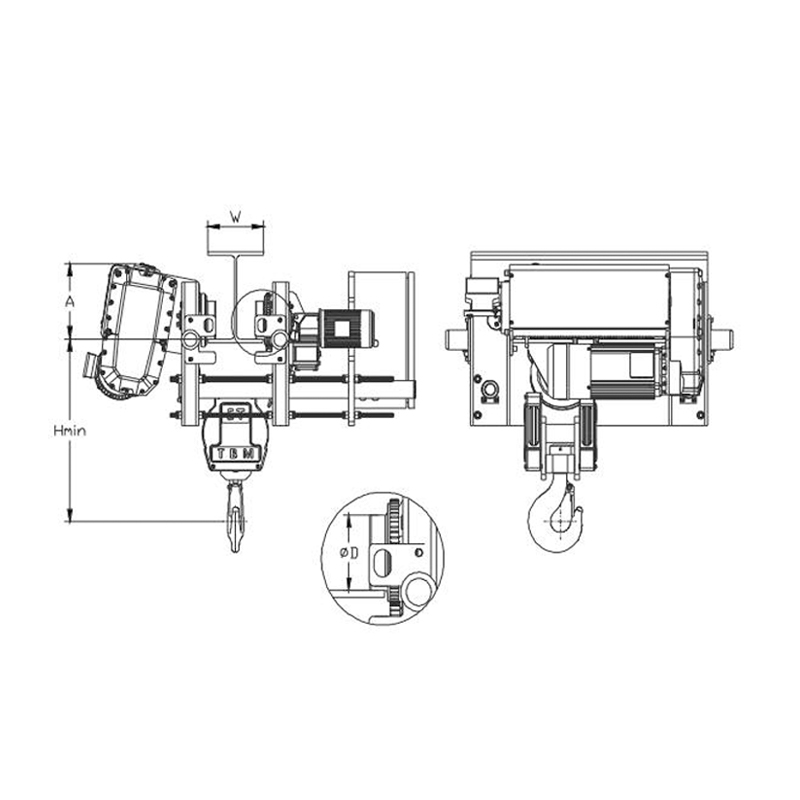 Low-Headroom Electric Wire Rope Hoist for Tight SpacesDesigned to minimize space usage, this hoist offers a compact headroom while maintaining high lifting capacity. It suits workshops with limited height, allowing a relatively large hook travel and improving flexibility where standard hoists cannot operate.View Product →
Maintenance and Service Condition
Performance changes over time. A hoist that is properly lubricated, with the brake correctly adjusted and the electrical connections tight, will maintain its rated capacity and speed for a much longer period. A hoist that is never inspected can lose performance even if it was correctly selected.
Brake wear is a common source of slip. Excessive clearance between the brake lining and the disc makes the load drift or the lowering speed uncontrollable. Wire rope failures are usually caused by mechanical wear and lack of lubrication. The limit switches, relays, and contactor contacts should also be verified regularly. A simple routine maintenance plan based on the manufacturer's service intervals is often enough to keep the hoist within its original performance parameters.
In short, the factors that impact hoist performance are not isolated. Load path, duty cycle, lift height and speed control, power supply, environment, installation fit, and maintenance all interact. The cost of overlooking one factor is usually not a sudden breakdown; it is a slow degradation that eventually reduces uptime. The safest way to choose a hoist is to provide your supplier with a complete description of the lifting task, including the load weight and handling method, the starts per hour, the ambient conditions, and the available headroom. A carefully matched hoist will always outperform a larger but poorly matched one. For a specific application check, discuss your project with our engineering team.
News

The company has always attached great importance to new product development and technological innovation, focusing on a high starting point, high configuration
Product Categories
Contact Us

No. 9 Tenglong Road, Huangze Industrial Function Zone, Huangze Town, Shengzhou City, Zhejiang Province, China

info@tbmhoist.com

+86 - 18957539688
